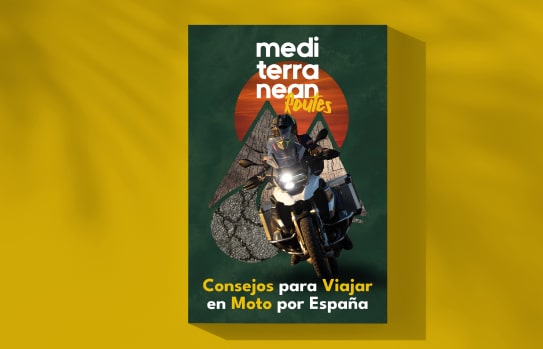
How to Plan a Motorcycle Holiday in Spain: Complete Guide for UK and European Riders
Published by Mediterranean Routes | Last updated: June 2026
Spain is one of the most rewarding motorcycle destinations in Europe — but planning a trip from the UK, Germany, the United States or Scandinavia is more involved than booking a flight and renting a bike. The distance, the language, the unfamiliar road network, the question of what licence you actually need, the insurance, the hotels that won’t leave your motorcycle on the street overnight — there is a lot to get right.
This guide covers everything. Not in vague generalities, but with the specific, practical information that international riders need to arrive in Spain prepared, confident, and ready to enjoy the road.
Whether you plan to organise the trip yourself or work with a specialist, the steps below will give you a clear picture of what’s involved — and where the complexity genuinely lies.
Step 1: Choose Your Region and Season
Spain is large, climatically varied, and different in character from one corner to the next. The region you choose will determine your ideal travel window — and getting the timing wrong is one of the most common mistakes international riders make.
Andalusia — March to May, and September to October
Andalusia is extraordinary in spring and early autumn. The Sierra Nevada, the white villages of the interior, the coastal roads between Almería and Málaga — all of them at their best when the temperature sits between 18°C and 26°C. Avoid July and August: the interior regularly exceeds 40°C, which makes long riding days genuinely unpleasant and potentially dangerous.
Northern Spain and the Pyrenees — June to September
The north is a different country to the south. Green, dramatic, often rainy in spring, spectacular in summer. The Cantabrian Coast, Asturias, the Basque Country and the Pyrenees are all best ridden from June through September, when the mountain passes are fully open and the weather is reliably good. The Pyrenees in particular rewards summer timing — high-altitude passes that are snowbound in April are transformed by July.
Central Spain, Castile, the Mediterranean Coast — April to October
The broad middle of the country and the Mediterranean coast offer the longest riding window. Spring and autumn are the sweet spots — mild temperatures, quieter roads, landscapes that change dramatically across a single day’s ride.
The key rule: match your route to your timing. A week in Andalusia in October is a very different experience to a week there in August. If you’re flexible on dates, build your itinerary around the destination, not the other way around.
Step 2: Decide How You Want to Experience Spain
Before you plan anything else, there is a more fundamental question to answer: do you want to organise this trip yourself, or do you want someone who knows Spain deeply to manage the logistics for you?
Both are valid approaches. The difference is in what you’re prepared to invest — not just financially, but in time, research and the willingness to navigate problems in a foreign language when they arise.
If you organise it yourself, you’ll spend significant time researching routes, finding motorcycle-friendly hotels, arranging rental, studying Spanish road rules, and preparing for contingencies. For experienced travellers who enjoy the planning process, this is part of the adventure.
If you work with a specialist, you trade that effort for local expertise. At Mediterranean Routes, both our self-guided and guided formats are built specifically for international riders who want Spain done properly — with verified routes, motorcycle-friendly hotels, full logistics management and 24/7 support — without spending months preparing from abroad. Our self-guided tours give you complete daily freedom backed by a dedicated Fixer; our guided tours put an expert local rider beside you for every kilometre.
Whichever path you choose, the steps that follow apply equally.
Step 3: Understand Your Licence Requirements
This is the detail that catches more international riders off guard than almost anything else. What licence do you actually need to ride legally in Spain?
Riders from EU countries: Your European driving licence is fully valid in Spain. No additional documentation is required. Spain recognises all EU category A licences directly.
Riders from the UK: Since Brexit, a UK driving licence is no longer automatically recognised in EU countries in the same way it was. For Spain specifically, your UK licence is valid for short stays — but obtaining an International Driving Permit (IDP) before you travel is strongly recommended. The IDP is an official translation of your licence recognised under the Vienna Convention, costs very little and takes minutes to obtain from the Post Office in the UK. Riding without one if asked to produce documentation can cause complications.
Riders from the United States, Canada, Australia and other non-EU countries: Your national licence is not automatically valid in Spain. You must carry your national licence and a valid IDP issued in your home country. The IDP must correspond to your national licence category — if your licence covers motorcycles above 125cc, your IDP must reflect this. Apply for yours through your national automobile association (AAA in the US, CAA in Canada, AA/RAC in the UK) before departure.
Minimum age: To rent a motorcycle in Spain, most operators — including Mediterranean Routes — require riders to be at least 25 years old and to hold a full motorcycle licence for a minimum of two years.
The practical advice: Get your IDP before you travel regardless of whether you think you need one. The cost is minimal, the process is fast, and it eliminates any uncertainty if you’re stopped by the Guardia Civil on a mountain road in Extremadura.
Step 4: Sort Out Your Insurance
When you rent a motorcycle in Spain through a reputable operator, the insurance situation is more straightforward than many riders expect.
At Mediterranean Routes, every rental motorcycle is covered by comprehensive insurance (todo riesgo) — the Spanish equivalent of fully comprehensive. You are covered for damage to the bike and for third-party liability from the moment you collect it.
There is, however, a standard excess (franquicia) — the amount you would be liable for in the event of a claim. This can be significantly reduced or eliminated entirely by paying a modest additional fee or leaving a refundable deposit. We strongly recommend taking this option: it removes the one variable that can turn a minor incident into a major headache.
Personal travel insurance is separate and equally important. Your motorcycle rental insurance covers the bike. Your personal travel insurance covers you — medical evacuation, hospitalisation, trip cancellation, lost luggage. For motorcycle travel specifically, make sure your policy includes coverage for motorised two-wheel vehicles. Many standard travel insurance policies exclude motorcycles or require a specific add-on. Read the terms carefully before you travel.
European Health Insurance Card (EHIC) / UK Global Health Insurance Card (GHIC): If you’re travelling from the UK or an EU country, carry your EHIC or GHIC. It doesn’t replace travel insurance, but it ensures you can access public healthcare in Spain at the same rate as Spanish residents. Given that Spain’s public hospitals are excellent, this card has real value in an emergency.
Step 5: Arrange Your Motorcycle
Unless you’re riding your own bike from home — which is perfectly feasible for European riders, but a significant undertaking — you’ll need to rent in Spain.
What to look for in a rental
The quality of motorcycles available for rent in Spain varies enormously. At the budget end, you’ll find ageing bikes with questionable maintenance histories. At the quality end, you’ll find late-model machines — BMW GS series, Triumph Tigers, Honda Africa Twins, KTM Adventures — that are inspected before every tour, equipped with panniers and top case, and delivered to you in proper riding condition.
At Mediterranean Routes, our fleet is renewed every two years and covers the full range of adventure and touring bikes. Every motorcycle is inspected and prepared specifically for your tour before collection. Your GPS route is pre-loaded before you collect the bike — you don’t arrive and spend an afternoon trying to programme a navigator in an unfamiliar system.
Practical considerations
- Panniers and luggage: Confirm that the rental includes side panniers and a rear top case. Without proper luggage capacity, a multi-day tour becomes a logistical problem. All Mediterranean Routes rentals include full luggage equipment as standard.
- Helmet: Most rental operators do not include helmets, for hygiene reasons. Bring your own if possible. If not, rent one from your operator — but confirm the quality standard before agreeing.
- Clothing and gear: Spain in summer can be very hot. High-visibility mesh gear is your friend. In mountain areas and on the northern coast, temperatures drop significantly in the evening — bring a mid-layer. Rain gear should always be packed regardless of forecast.
Step 6: Plan Your Route
This is where the difference between a good motorcycle holiday and a great one is made.
Spain’s road network divides into two worlds. The motorways (autopistas and autovías) are fast, well-maintained, and almost entirely without interest for a motorcyclist. The secondary roads — the N-roads, the C-roads, the unnumbered tracks through mountain passes — are where Spain reveals itself.
The challenge for international riders planning from abroad is knowing which of those secondary roads are genuinely worth riding and which are simply rough tracks that lead to a closed gate or a 45-minute backtrack. That knowledge only comes from riding them.
A few principles for self-planned routes:
Prioritise secondary roads. Any route that includes significant motorway sections is a route that misses the point. The journey from Ronda to Granada via the A-92 takes 90 minutes. Via the backroads through the Alpujarras, it takes four hours — and it is one of the finest rides in southern Europe.
Build in less distance than you think you need. International riders often underestimate how much time they’ll want to spend not riding — eating lunch in a village square, exploring a medieval castle, sitting in the sun outside a bar at 6pm. 200 kilometres of Spanish secondary roads takes longer and delivers more than 200 kilometres of motorway. Plan for 200-280km per day maximum on mountain routes.
Account for altitude. The Pyrenees, the Sierra Nevada, the Picos de Europa — passes that look short on a map involve significant ascent and descent. A 15-kilometre section of a high mountain pass can take 45 minutes each way. Build this into your daily planning.
Verify road status before you commit. Mountain roads in Spain can be closed seasonally, under repair, or temporarily inaccessible due to weather events. A route that looks perfect in March may have a closed pass. Local knowledge — or a Fixer who checks conditions daily — is genuinely invaluable here.
For a deeper guide to Spain’s best motorcycle roads, see our article on the best motorcycle routes in Spain.
Step 7: Book Motorcycle-Friendly Accommodation
Finding hotels that are genuinely good for motorcyclists is harder than it sounds.
“Motorcycle friendly” means more than accepting bikes. It means: covered, secure overnight parking (not a car park where your bike gets rained on or knocked over); easy access for loaded touring bikes; ideally a hosing-down area or at least water access for cleaning; staff who understand that you may arrive muddy, late, and needing somewhere to dry kit.
Hotels that advertise themselves as motorcycle-friendly but offer only a corner of an outdoor car park are common. Hotels that genuinely understand motorcyclist needs — and actively prepare for them — are rarer and worth seeking out.
At Mediterranean Routes, every hotel in our tours is personally selected and verified for motorcyclists. We know which properties have the secure underground parking, which have the heated boot rooms, which serve breakfast early enough for a 7am departure. This selection is one of the aspects of our tours that riders most frequently mention in their feedback — the consistent quality and appropriateness of the accommodation removes a layer of uncertainty that many independent travellers underestimate.
If you’re booking independently, look for: hotels with explicit mentions of garaje cubierto (covered garage) or aparcamiento motos (motorcycle parking); rural hotels (casas rurales) that often have private enclosed parking; and rider communities like the Biker’s Welcome network, which lists vetted motorcycle-friendly properties across Spain.
Step 8: Understand Spanish Road Rules
Spain’s traffic regulations follow broadly the same principles as other European countries, with a few specifics worth knowing:
- Speed limits: 120 km/h on motorways, 90 km/h on secondary roads outside urban areas, 50 km/h in towns and villages unless otherwise signed.
- Alcohol limit: 0.5 grams per litre of blood (0.25 mg/l in breath) for most drivers. For riders with less than two years of licence: 0.3 g/l. The Guardia Civil conduct roadside checks, particularly on holiday weekends.
- Mobile phones: Strictly prohibited while riding, including at traffic lights. Hands-free is not an exception — if the phone is in your hand, it’s an offence.
- Reflective vest: You are legally required to wear a high-visibility vest if you stop on the road or hard shoulder. Keep one accessible — not buried in your top case.
- Motorway tolls: Many Spanish motorways are tolled. Carry a credit or debit card — most toll booths are now unmanned and card-only. Cash lanes are becoming rare.
- Guardia Civil: Spain’s traffic police are serious, professional, and empowered to issue on-the-spot fines. They are also, in our experience, respectful and fair with international riders who are correctly documented. Have your licence, IDP, rental documents and insurance certificate accessible.
Step 9: Prepare for the Unexpected
Even the best-planned motorcycle trip encounters the unexpected. What separates a well-managed surprise from a trip-ruining crisis is preparation.
Mechanical issues: Establish before you travel what happens if the bike breaks down. With Mediterranean Routes, breakdown assistance is included — we manage the resolution and, if necessary, provide a replacement bike. If you’re renting independently, confirm the operator’s breakdown policy in writing before you pay.
Weather changes: Spain’s weather is generally reliable but not unconditional. Mountain passes can close suddenly due to snow or rain in spring and autumn. The north coast can deliver three days of continuous rain in July. Build flexibility into your itinerary — if you have one or two days without fixed hotel bookings, you can adapt to conditions without the stress of unrecoverable bookings.
Medical emergencies: Know the Spanish emergency number: 112. It connects to police, ambulance and fire services and English-speaking operators are available. Carry your insurance details, EHIC/GHIC and any personal medical information in a document that can be found easily if you’re incapacitated.
Language: In cities and tourist areas, English is widely spoken. In rural Spain — which is where the best motorcycle roads are — it is considerably less so. Basic Spanish phrases for motorcycle-related situations are worth learning: “Se ha averiado la moto” (the bike has broken down), “Necesito un mecánico” (I need a mechanic), “¿Dónde está el garaje más cercano?” (Where is the nearest garage?). Your Fixer, if travelling with Mediterranean Routes, handles all of this on your behalf.
Why Planning with Mediterranean Routes Is Different
Everything described above — the licence research, the insurance comparisons, the hotel vetting, the route validation, the weather monitoring, the breakdown logistics — is work that Mediterranean Routes does for you before and during the trip.
The reason our tours exist is precisely because this planning burden is real. International riders who love motorcycles and want to experience Spain authentically face a genuine challenge: the logistics of doing it properly from outside the country are significant, and the cost of getting them wrong — a broken-down bike with no support, a hotel that rejects your motorcycle, a mountain pass you didn’t know was closed — can wreck a trip you’ve been anticipating for a year.
When you travel with us, you arrive at the airport and a transfer takes you to your first hotel. Your bike is waiting, prepared, with the route already loaded. Your Fixer has checked the day’s weather and confirmed the roads. Your dossier tells you exactly what’s ahead — not just the directions, but the cultural context, the gastronomic stops, the stories behind the landscapes you’ll ride through.
You don’t have to have spent six months researching to feel like you know what you’re doing. You just have to show up.
Frequently Asked Questions
What licence do I need to ride a motorcycle in Spain as a UK rider?
UK riders need their UK driving licence plus an International Driving Permit (IDP) when riding in Spain. The IDP acts as an official translation of your licence recognised under international conventions. You can obtain one quickly and cheaply from the Post Office in the UK. Without an IDP, you may face difficulties if stopped by Spanish traffic police (Guardia Civil).
Do EU riders need any special documentation to ride motorcycles in Spain?
No. Riders from EU member states can use their European driving licence directly in Spain. No additional documentation is required. Spain fully recognises all EU category A motorcycle licences.
What is the best time of year for a motorcycle holiday in Spain?
It depends on where you want to ride. Andalusia is best in March to May and September to October — summers are extremely hot. Northern Spain and the Pyrenees are ideal from June to September, when mountain passes are open and weather is reliably good. The rest of Spain — central regions, Castile, the Mediterranean coast — offers a long riding window from April to October.
Is motorcycle insurance included when I rent a bike in Spain?
With reputable operators like Mediterranean Routes, yes. Rental motorcycles are covered by comprehensive insurance (todo riesgo). There is typically a standard excess (franquicia) that can be reduced or eliminated for an additional fee. Personal travel insurance is separate and equally important — ensure your policy explicitly covers motorcycle riding, as many standard travel policies exclude it.
Do I need an International Driving Permit (IDP) to rent a motorcycle in Spain?
If you are from a non-EU country (including the UK post-Brexit, the USA, Canada, Australia), an IDP is required alongside your national licence to rent and ride legally. EU riders do not need an IDP. Rental operators will generally check your documentation before handing over a bike.
How do I find motorcycle-friendly hotels in Spain?
Look for hotels that explicitly offer garaje cubierto (covered garage) rather than just general parking. Rural hotels (casas rurales) often have private enclosed parking. Specialist motorcycle tour operators like Mediterranean Routes select and vet all accommodation specifically for motorcyclists — every hotel in our tours has been personally checked for secure parking, early breakfast availability and rider-appropriate facilities.
How many kilometres should I plan per day on a motorcycle tour in Spain?
On Spanish secondary roads — which are the ones worth riding — plan for 200 to 280 kilometres per day maximum on mountain routes, and up to 300-350 on more open terrain. Factor in the time you’ll want to spend stopped: meals, viewpoints, villages, coffee. The best days on a motorcycle tour in Spain are rarely the longest ones in the saddle.
What happens if my motorcycle breaks down during a tour in Spain?
If you’re riding with Mediterranean Routes, breakdown assistance is fully covered. Your Fixer coordinates the resolution — a recovery vehicle, a mechanic, or if necessary, a replacement bike — so you lose as little riding time as possible. If you’re renting independently, establish the operator’s breakdown policy in writing before you pay. Confirm whether recovery is included and what the response time guarantee is.
Can I take my own motorcycle to Spain from the UK?
Yes. You can ride your own bike to Spain via the Channel Tunnel or a ferry crossing (Portsmouth–Bilbao or Plymouth–Santander are popular routes for direct access to northern Spain). You’ll need your own comprehensive insurance that covers Spain, proof of ownership or a letter of authorisation if the bike is not in your name, and your licence and IDP. Many UK riders doing extended Iberian tours choose this route — it removes the rental cost but adds significantly to the overall journey.
How far in advance should I book a motorcycle tour in Spain?
For summer dates (June–September) in popular regions like the Pyrenees or northern Spain, booking four to six months in advance is advisable — particularly if you want specific dates. Spring and autumn availability is generally more flexible. At Mediterranean Routes, because tours are built around your schedule rather than fixed departure dates, we can often accommodate shorter lead times outside peak season.
Ready to Start Planning?
If you’d like to discuss your specific trip — the region, the timing, the number of riders, the format — contact Vicente directly. Mediterranean Routes replies within 24 hours and offers a free personalised video briefing to walk through the options before you commit to anything.
The planning is the hard part. We handle it. The ride is yours.
Plan Your Spain Motorcycle Tour →
Related reading:
Best Motorcycle Routes in Spain — Complete Guide
Self-Guided vs Guided Motorcycle Tours in Spain: Which Is Right for You?